

Chicken Road has become one of the most talked-about titles in the instant-win corner of the casino floor, and plenty of UK slot players are curious whether the hype holds up. Rather than spinning reels and matching symbols, this release asks you to guide a nervy chicken across a hazard-filled road, banking a growing multiplier with every safe step. It is quick, tense, and refreshingly easy to grasp within a single round.
Built by InOut Games and released in April 2024, the game sits in the crash and step-multiplier family alongside names such as Aviator and Mines. It is provably fair, licensed under a Curacao framework, and runs directly in the browser, which is part of why it spread so fast across streaming clips and social feeds. The appeal is not flashy visuals but the push-your-luck decision at the heart of every attempt.
This review walks through the numbers that matter, from the return-to-player figure to the eye-watering top multipliers, and explains how the four difficulty tiers reshape the risk. We also cover the free demo, real money play, mobile access, and sensible bankroll habits so you know exactly what to expect before committing a single stake.
Because Chicken Road is a crash game rather than a classic online slot, some familiar slot terms simply do not apply. Where that is the case, we explain what the game uses instead rather than inventing features it does not have. If you want to try it, you will find it within the wider casino game catalogue at Paddy Power Casino.
Meet the Studio Behind the Chicken: InOut Games
InOut Games is a relatively young B2B supplier that launched in 2024 and quickly carved out a niche in the fast-session, instant-play category. Its catalogue leans heavily on crash, mines, plinko, and chart-style formats rather than sprawling video slots, which keeps the studio focused on a small set of mechanics that it refines and re-skins with fresh themes.
The developer builds everything in HTML5 and ships titles that run without a download, which suits the mobile-first audiences that first pushed Chicken Road into the spotlight. Provable fairness is a recurring selling point across the range, giving players a way to verify each round independently rather than relying on a testing-lab seal alone.
Chicken Road was among the studio’s earliest breakout releases, and its success spawned a follow-up in Chicken Road 2.0. The original still tends to be the version players seek out first, largely because of its higher headline return figure and the recognisable golden-egg reward that closes a successful run.
For UK players, the practical takeaway is that this is a modern, transparency-focused casino game from a provider that specialises in this exact style. That specialism shows in the tight, uncluttered interface and the way the whole experience is stripped back to one clear decision per step.
The Numbers That Matter: Return, Risk and Difficulty
The headline return-to-player figure for the original Chicken Road is quoted at ninety-eight per cent, which sits comfortably above the level you find in a great many instant-style titles. That figure is a long-run theoretical average and never a promise for any single session, but it does give a sense of how the payout structure is weighted over thousands of rounds.
Volatility is not fixed here, and that is one of the more interesting design choices. Instead of a single fixed variance, the risk profile shifts entirely depending on which of the four difficulty tiers you pick. Easy mode keeps danger low and prizes modest, while Hardcore turns the game into a genuine white-knuckle affair where a single misstep ends everything early.
Each tier changes three things at once: how many steps stand between you and the finish, how steeply the multiplier climbs, and how likely the chicken is to come to grief on any given move. That means you are effectively choosing your own volatility before the round even begins, which gives the game far more flexibility than a slot with one locked-in variance rating.
The table below gathers the core specifications in one place so you can size up the release at a glance before reading on into the payout detail.
| Attribute | Detail |
|---|---|
| Studio | InOut Games |
| Format | Crash / step-multiplier game |
| Release date | April 2024 |
| RTP | 98% |
| Volatility | Adjustable → set by difficulty tier |
| Difficulty tiers | Easy · Medium · Hard · Hardcore |
| Fairness | Provably fair, RNG-audited |
| Platform | HTML5 (desktop · tablet · mobile) |
| Demo mode | Available, no registration required |
How High Can the Multiplier Climb?
This is where Chicken Road earns its reputation. On the safest setting the ceiling is deliberately gentle, but crank the difficulty up and the theoretical top multipliers reach almost absurd heights. In Hardcore mode the numbers run into the millions of times your stake, which explains why the clips that spread online tend to feature that tier.
There is an important caveat, though. While the maths can technically generate a colossal multiplier, casinos apply a maximum win cap, so the real-world payout is limited regardless of how far the theoretical figure stretches. The commonly cited top payout sits around twenty thousand in the base currency, and the exact cap can vary from one operator to another.
The practical result is that chasing the very highest multipliers is a low-probability gamble by design. The further your chicken walks in a high-risk tier, the greater the chance the next step is its last, so most disciplined players bank sensible mid-range multipliers far more often than they hold out for a headline figure.
The comparison below shows how the four tiers trade safety against reward, using the step counts, multiplier ranges, and rough loss odds reported for the game. Read the loss column as the chance of failing on any given step within that mode.
| Tier | Steps to Finish | Multiplier Range | Approx. Loss Odds Per Step |
|---|---|---|---|
| Easy | 24 | 1.03× → 19.44× | 1 in 25 |
| Medium | 22 | 1.12× → 1,788× | 3 in 25 |
| Hard | 20 | 1.23× → 41,321× | 5 in 25 |
| Hardcore | 15 | 1.63× → 2,542,251× | 10 in 25 |
Reels, Paylines and Symbols: What Replaces Them Here
If you have arrived expecting spinning reels, a grid of rows, and a set of paylines or ways to win, it is worth resetting those expectations. Chicken Road is a crash-style game, so it has none of those traditional slot components. There are no reels to spin, no rows of symbols, and no fixed paylines running left to right across a matrix.
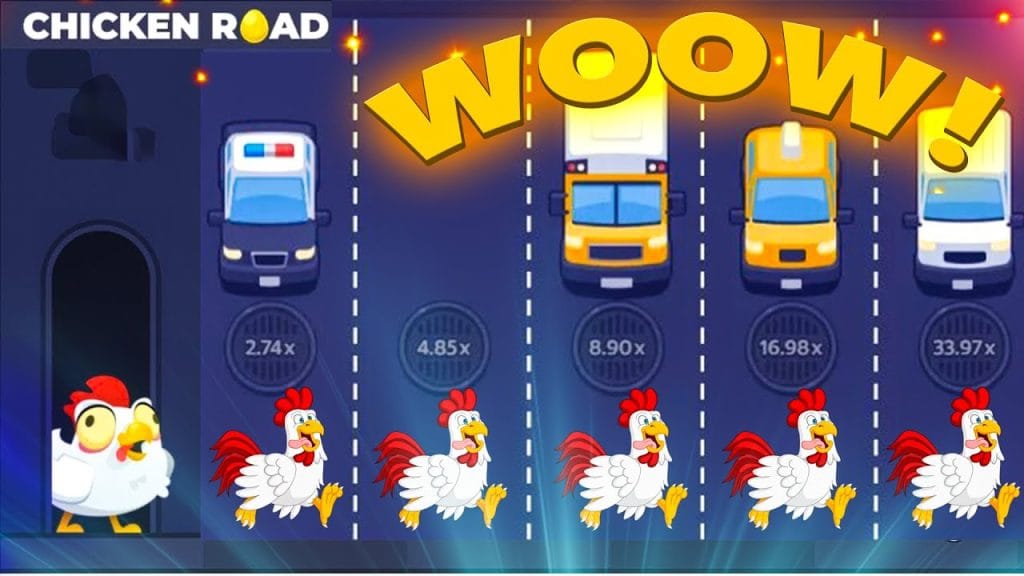
In place of paylines, the game gives you a lane of hazards and a single progression mechanic. Value is created not by landing matching icons but by advancing across manhole covers one at a time, with the multiplier attached to your stake rising each time you survive a step. Your payout is simply the stake multiplied by wherever you decide to stop.
The same logic applies to wild and scatter symbols. This title does not feature wilds, scatters, or bonus symbols in the way a video slot would, because there is no reel set for them to appear on. The tension that scatters usually create is instead delivered by the escalating risk of the next step going wrong.
None of this makes the game less engaging; it simply relocates the decision-making. A slot resolves its outcome the instant the reels stop, whereas Chicken Road stretches a single result across a series of active choices, and that is the core difference UK players should keep in mind when they compare the two formats.
Stakes and Betting Flexibility for Every Bankroll
One of the quieter strengths of the game is how accommodating the betting range tends to be. Stakes are flexible and typically start from very small amounts, which suits cautious players who want to feel out a tier before committing anything meaningful. The exact minimum and maximum can differ between casinos, so it is always worth checking the stake selector once you open the game.
Because you set your stake before the round and the multiplier is applied to that figure, your bet size and your cash-out target work together. A small flat stake in a low tier produces a slow, steady experience, while a larger stake in a high tier swings the same round into far more volatile territory even without touching the difficulty.
This flexibility is what makes classic betting systems tempting to some players. Approaches borrowed from table games, such as flat staking or gradual progression, are technically possible here because each round has a clean stake-in, cash-out-out structure. That does not make them winning systems, but it does explain why the game attracts strategy-minded players.
For most people, the sensible starting point is a modest flat stake in Easy or Medium while you learn how the pace feels. You can always scale up later, and keeping early stakes small buys you room to observe your own habits without draining a bankroll during the learning curve.
Bonus Mechanics and In-Game Tools
Set expectations correctly here: Chicken Road does not offer the layered bonus rounds, free spins, or pick-me features you would find in a modern video slot. There is no free-spins round in the traditional sense, and no bonus wheel bolted onto the main game. The reward system is the step-multiplier mechanic itself, which keeps everything focused on the core decision.
What the game does include are practical playing tools rather than bonus modifiers. Depending on the version and casino, you may find an auto cash-out option that banks your winnings automatically once a target multiplier is reached, along with round history so you can review previous outcomes. These help you stick to a plan rather than deciding in the heat of the moment.
Some branded or enhanced editions of the title add extra layers, and separate InOut releases in the same family experiment with their own twists. However, for the standard Chicken Road most UK players will encounter, the honest summary is that features are deliberately minimal and the appeal lies in that simplicity rather than in a stack of bonus modes.
The short table below lays out which mechanics are present and which are absent, so there is no confusion about what you are getting when you load the game.
| Feature | Present? | Note |
|---|---|---|
| Step multiplier | ✓ | Core mechanic; climbs each safe step |
| Manual cash-out | ✓ | Bank winnings at any point |
| Auto cash-out | ✓ | Availability can vary by casino |
| Adjustable difficulty | ✓ | Four tiers set the volatility |
| Free spins round | ✗ | Not part of the standard game |
| Wild / scatter symbols | ✗ | No reel set for symbols |
| Paylines / ways to win | ✗ | Crash format, not a slot grid |
A First-Timer’s Walkthrough
The learning curve is gentle, but a clear routine helps you avoid the common beginner mistake of changing plans mid-round. Treat your first handful of attempts as calibration rather than a serious tilt at the top prizes, and the game becomes far easier to enjoy responsibly.
The list below sets out a straightforward sequence to get you from opening the game to banking a first win. It is written for the standard version, so the exact button labels may differ slightly depending on the casino skin you are using.
- Open Chicken Road from the casino catalogue and let the interface load fully before you touch anything.
- Choose a difficulty tier; Easy is the sensible starting point while you learn the rhythm of the steps.
- Set a small stake using the bet selector, keeping it to a fraction of your session budget.
- Decide your cash-out target in advance, for example a modest multiplier you would be happy to bank.
- Start the round and move the chicken forward one step at a time, watching the multiplier climb.
- Cash out the moment you reach your pre-set target rather than talking yourself into one more step.
- Review the round in your history, then repeat with the same discipline or adjust your plan calmly between rounds.
The single most valuable habit in that list is pre-committing to a cash-out point. Deciding while the multiplier is rising means negotiating with your own adrenaline, and that is exactly when disciplined plans tend to fall apart. Lock the target in first, then simply execute it.
Once the basic loop feels natural, you can experiment with higher tiers using minimum stakes to see how the algorithm behaves before risking anything larger. That measured approach keeps the learning cheap and the experience under your control.
Trying Before You Stake: The Free Demo
Chicken Road comes with a genuine free demo, and it is one of the better ways to understand the game before committing real funds. The demo mirrors the real money version closely, using the same layout, the same controls, and the same underlying maths, so nothing you learn in practice mode is wasted when you switch across.
Registration is generally not required to launch the demo on the provider’s own presentation, and you are handed a large pot of virtual credits to play with. That means you can test every difficulty tier and every cash-out strategy at zero financial risk, which is invaluable for spotting your own tendencies before money is on the line.
The real benefit of the demo is not that it teaches you the rules, which take minutes to grasp, but that it exposes your habits. Many players do not lose because they misunderstand the game; they lose because they abandon their plan halfway through a promising round. Practice mode is where you can catch that tendency safely.
Use the free version as a test lab. Give yourself a set number of rounds, name the pattern you fall into, and only move to real money once you can hold a plan consistently. That single step separates a controlled session from an impulsive one.
Stepping Up to Real Money Play
When you are ready to play for real, the transition is seamless because the demo and the cash version behave identically. The only difference is that your stake now draws on real funds and your winnings are real too, which naturally changes how the same decisions feel under pressure.
Before you deposit, it makes sense to confirm the game is available in your account catalogue and to check the stake limits and any maximum win cap that applies at your chosen casino. These details vary between operators, and knowing them up front prevents surprises when you reach for a bigger multiplier.
Real money play rewards the same discipline you built in the demo. Set a session budget you are comfortable losing, keep individual stakes small relative to that budget, and resist the urge to increase your bet size to chase back a losing run. The maths does not remember your previous rounds, and neither should your stake plan.
UK players will find the title inside the broader collection of online slots and instant games, where you can move between practice and real play once your account is set up and any age and identity checks are complete.
Playing on the Move: Mobile and Browser Access
Because the game is built in HTML5, it runs directly in a mobile browser without any separate app to install. That lightweight architecture is a large part of why the title performs smoothly even on mid-range handsets, and it means the mobile experience keeps every feature found on desktop rather than stripping anything out.
Android players simply open the game through their phone’s browser, and iPhone and iPad users do the same through Safari or their preferred browser. There is no dedicated download required, though you can add a shortcut to your home screen if you want quick, app-like access without hunting through the casino menu each time.
The interface is genuinely well suited to smaller screens, with the key controls kept large and central so the cash-out button is always easy to reach in a hurry. That matters in a game where a single tap decides whether you bank a multiplier or lose the round, and it is one area where the minimalist design pays off.
Browser play on a laptop or desktop offers the same content with a little more screen real estate, which some players prefer for reading the round history at a glance. Either way, the core gameplay, the difficulty tiers, and the cash-out logic are identical across devices.
How a Round Actually Feels
The gaming experience is built around a very particular kind of tension. Each step is a tiny, deliberate choice between pushing your luck for a bigger multiplier and walking away with what you have already secured. That rhythm of small decisions with immediate consequences is what keeps players returning for another round.
Unlike some crash titles that hinge on split-second reactions, Chicken Road leans more on nerve and judgement than on lightning reflexes. You are not racing a timer so much as talking yourself into or out of the next step, which gives the game a slightly more thoughtful, strategic flavour than a pure reaction test.
The presentation is playful and stripped back, with a wide-eyed chicken, arcade-style sound, and flames that underline the danger without cluttering the screen. There is no heavy storyline to follow, and that is deliberate, because the whole design funnels your attention onto the single question of whether to advance or cash out.
What emerges is a fast, self-contained loop that works equally well for a two-minute break or a longer sitting. The catch is that the same tension that makes it moreish is exactly why a firm plan matters, since the game is engineered to make one more step feel irresistible.
Games in a Similar Vein
If the push-your-luck format appeals, there is a whole cluster of instant and crash games that scratch the same itch. Some use a climbing multiplier tied to a moving object, others use a grid of hidden hazards, but they all share that core loop of a rising reward and a sudden, decisive end.
The most obvious relative is Chicken Road 2.0, the studio’s own follow-up. It keeps the same step-based mechanic but swaps the sewer setting for a busier road-and-traffic theme, tightens the presentation, and carries a lower return figure than the original. Fans of the first game will feel immediately at home, albeit with slightly different maths.
Beyond the InOut family, titles such as Aviator, Mines, Balloon, and Spaceman offer their own spin on the same idea. Aviator ties the multiplier to a climbing plane you must exit before it flies off, while Mines borrows from Minesweeper by asking you to reveal safe tiles and avoid hidden bombs. Each rewards timing and a clear exit plan over symbol matching.
The comparison below places a few popular alternatives side by side so you can see how Chicken Road fits into the wider crash landscape. Return figures shown are the commonly quoted headline values and can differ by casino or version.
| Title | Studio | Style | Headline RTP |
|---|---|---|---|
| Chicken Road | InOut Games | Step multiplier · road crossing | 98% |
| Chicken Road 2.0 | InOut Games | Step multiplier · traffic theme | 95.5% |
| Aviator | Spribe | Climbing-plane crash | ~97% |
| Mines | Varies | Grid · reveal safe tiles | Varies |
| Balloon | Varies | Inflate-and-cash-out crash | Varies |
Weighing It Up: Strengths and Shortcomings
No game suits everyone, and Chicken Road is no exception. Its greatest strengths are also, for certain players, its limitations. The stripped-back design that makes it so approachable is the same thing that leaves feature-hungry slot fans wanting more variety from a session.
On the positive side, the high headline return, the adjustable risk, and the genuine free demo make it easy to recommend as a low-friction, transparent option. Add in the provably fair system and the smooth mobile performance, and you have a title that respects both newcomers and players who like to verify the maths for themselves.
The trade-offs are real, though. The absence of bonus rounds, free spins, and the lack of an autoplay tool in some versions can feel sparse next to a modern video slot, and the highest multipliers are so improbable that they function more as marketing than realistic targets. The low-return follow-up also muddies the picture for players who assume all versions play the same.
The table below sums up the balance so you can decide whether the format matches your taste before you load it.
| In Its Favour | Points to Consider |
|---|---|
| ✓ High 98% headline return | ✗ No free-spins or bonus rounds |
| ✓ Four adjustable risk tiers | ✗ Top multipliers wildly improbable |
| ✓ Genuine no-registration demo | ✗ Win capped well below theoretical max |
| ✓ Provably fair and transparent | ✗ Sparse next to feature-rich slots |
| ✓ Smooth on mobile and browser | ✗ Sequel carries a lower return |
Managing Your Bankroll Sensibly
Because the game is so quick, rounds can stack up faster than you notice, which makes a bankroll plan more important here than in a slower title. Decide before you start how much of your money is available for the whole session, and treat that figure as a ceiling you will not top up mid-play.
A widely used guideline among disciplined players is to keep each individual stake to a small fraction of the session bankroll. This will never guarantee a win, but it does prevent a single unlucky run from wiping you out, and it keeps you in the game long enough for the return figure to have any meaning at all.
It also helps to anchor your cash-out decisions to a range rather than a fantasy figure. Telling yourself you will bank somewhere in a modest band gives you structure, whereas holding out for a life-changing multiplier usually ends with the chicken meeting an early and expensive end. Pre-commit, then follow through.
Finally, resist the temptation to chase losses by raising your stake after a bad run. Each round is independent, so a string of losses does not make the next win any more due. Steady flat staking in a lower tier is almost always the calmer, more sustainable way to play.
Staying in Control and Playing Responsibly
Quick, high-frequency games like this one call for a bit more self-awareness than a standard slot session, simply because the format is built to make “just one more round” feel harmless. The healthiest mindset is to treat gambling as entertainment you pay for, not a tool for making money or clawing back what you have already lost. Holding onto that distinction is what responsible play really comes down to.
A few practical steps make a real difference. Before you load the game, decide on your deposit, loss, and time limits rather than working them out mid-session. Most licensed UK casinos also offer built-in controls such as reality check pop-ups, temporary cooling-off periods, and full self-exclusion, and reaching for these tools is a smart habit, not an admission of a problem.
It also helps to recognise when a session has quietly turned from fun into something else. Common red flags include staying at the screen longer than you had planned, increasing your stake to chase back a loss, or dipping into money earmarked for bills or everyday spending. Spotting any of these early is the cue to close the game, walk away, and give yourself a proper break before deciding whether to return.
Support is there if you need it, and asking for it costs nothing. UK players can reach GamCare or the National Gambling Helpline for free, confidential advice at any hour. Getting in touch sooner rather than later tends to make things far easier to manage, and the simplest rule of all still applies: only ever stake money you can genuinely afford to lose.
Frequently Asked Questions
Is Chicken Road actually a slot?
Not in the traditional sense. It is a crash-style, step-multiplier game rather than a reel slot, so it has no paylines, reels, or spinning symbols. You win by advancing a chicken across a road and cashing out your growing multiplier before a step ends the round.
What is the RTP of Chicken Road?
The original Chicken Road carries a headline return-to-player figure of ninety-eight per cent, which is higher than many instant-style games. Remember this is a long-run theoretical average across countless rounds and never a guarantee of what any single session will return to you.
How much can I win on Chicken Road?
Theoretical top multipliers in the highest tier reach into the millions of times your stake, but casinos apply a maximum win cap, commonly cited around twenty thousand in the base currency. The exact ceiling depends on the operator, so check the limits at your chosen casino first.
Can I try Chicken Road for free before staking?
Yes. A free demo is available and generally needs no registration, handing you a large pot of virtual credits. It mirrors the real money version exactly, so it is ideal for testing every difficulty tier and practising your cash-out timing at zero financial risk.
Does Chicken Road work on mobile phones?
It does. The game is built in HTML5 and runs in any modern browser on Android and iPhone without a separate download. You can add a home-screen shortcut for quick access, and the mobile version keeps all the features found on desktop.
Are there any free spins or bonus rounds?
The standard game does not include free spins, wild or scatter symbols, or traditional bonus rounds. Its reward system is the step-multiplier mechanic itself, supported by practical tools such as manual and auto cash-out rather than layered bonus features.
How is Chicken Road different from Chicken Road 2.0?
The sequel keeps the same step-based crash loop but changes the theme from a sewer setting to a busier road-and-traffic look, with tighter presentation. The most notable difference for players is a lower return figure of ninety-five and a half per cent compared with the original.
Is Chicken Road fair?
The game uses a provably fair system, meaning each round can be independently verified by the player after it ends. Combined with RNG auditing and its Curacao licensing, this gives you a transparent way to confirm outcomes rather than relying on trust alone.